
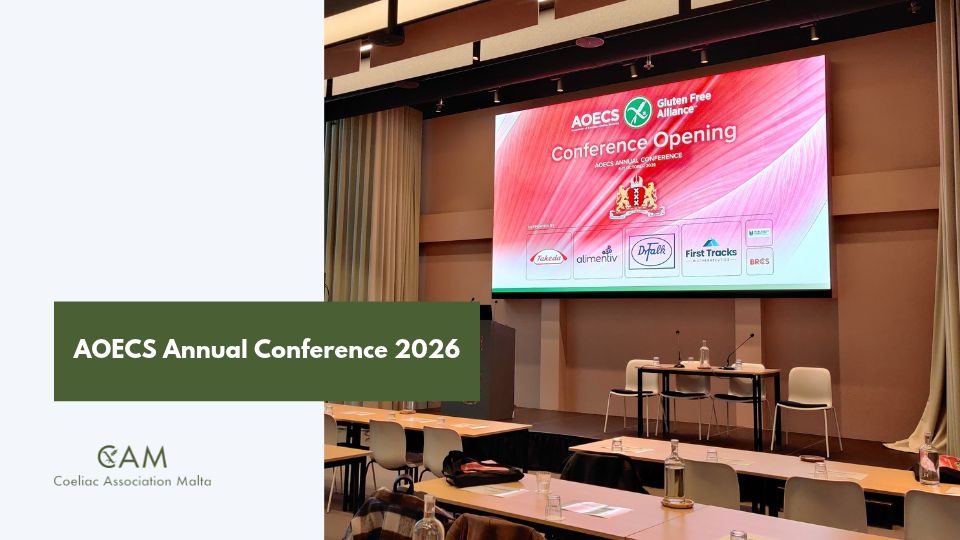
The AOECS Annual Conference 2026 was held in Amsterdam between 8-11 October, welcoming members and researchers from all over Europe and beyond.
We first start with a summary and takeaways from Friday’s talks.
The Future of Coeliac Disease
The main focus of this conference was looking into the future of coeliac disease. The discussions can be split into these categories:
- Methods to diagnosing Coeliac Disease
- Potential Treatments
- The Persistent Challenges of Coeliac Disease
Methods to diagnosing Coeliac Disease
As the prevalence of coeliac disease is on the rise, methods to decrease the percentage of undiagnosed patients are constantly being discussed. Mass screening programmes such as what has been introduced in Italy are considered as a good solution to balance against misdiagnosing coeliac disease.
This however may not be a “one size fits all” solution, there would still need to be further analysis in terms of who to screen and the costs involved. In her keynote speech, Dr. Iris Jonkers, Associate Professor of Immunogenetics and President-Elect of the ISSCD, mentioned that targeting screening for coeliac disease early in childhood, under 10 years old, is seen to be a good approach.
Research has also led to finding a potential new method to diagnosing patients with coeliac disease which would not require what is known as the gluten challenge. A 6 to 8 week period before being tested where gluten needs to be introduced to the diet. Eliminating this process could also help to increase the number of patients diagnosed with coeliac disease.
Potential Treatments
Through research and clinical trials there are several potential methods to find a form of treatment for coeliac disease, besides the gluten-free diet. Any potential treatment however, would not remove the need for a gluten-free diet. They would act as a safety net to any accidental gluten exposure.
Furthermore, any potential treatment would require further analysis such as:
- Does the treatment apply to all patients?
- Do all patients need an additional treatment apart from the gluten-free diet?
That being said, there are positive signs for potential treatments for coeliac disease in the coming years.
The Persistent Challenges of Coeliac Disease
Every medical condition comes with its own challenges, the challenges of coeliac disease range from the diagnosis and follow-ups, to the social impact of coeliac disease, both on the patients and the parents.
Medical Perspective: Diagnosis and Follow-ups
Given that data suggests that the prevalence of coeliac disease is on the increase, misdiagnosis is a common issue. Symptoms being generic or similar to other conditions at times lead to misinterpreting results. This could also be due to not following the right process when diagnosing coeliac disease.
Follow-up processes for coeliac disease have also become an area of interest. There is very little data on how follow-ups for coeliac patients should be handled.
Social Perspective
Both as a patient and as a parent, there are a lot of anxiety issues. Talks delved into aspects of how patients growing up, leaving home and starting to live alone or with roommates are challenging times and the need to find different ways to adapt.
On the other hand, parents can be more anxious at times due to the uncertainty of the symptoms, especially in cases of asymptomatic patients.
A very important point that was discussed was that mistakes are also part of the process of dealing with coeliac disease.
Other takeaways during Friday’s talks
- Asymptomatic patients still show signs of improvements after switching to a gluten-free diet.
- Coeliac Disease is considered as a public health issue.
- It is important for doctors and patients to have a unified message. In other words, a healthy link between patient organisations and medical organisations will lead to further improvements to people with coeliac disease.
Saturday: AOECS General Assembly
AOECS Members
Members have welcomed a new coeliac society representing Bulgaria.
Furthermore, in line with the updated AOECS statute, full membership also applies to non-European organisations. Three organisations who have been Affiliate Members, Mexico, US and Jordan, are now officially full members of AOECS.
We welcome all organisations and look forward to collaborating with them in the future.
AOECS and CYE Board Members
New board members have been elected for AOECS and CYE Board. We wish them all the best for the upcoming terms.